
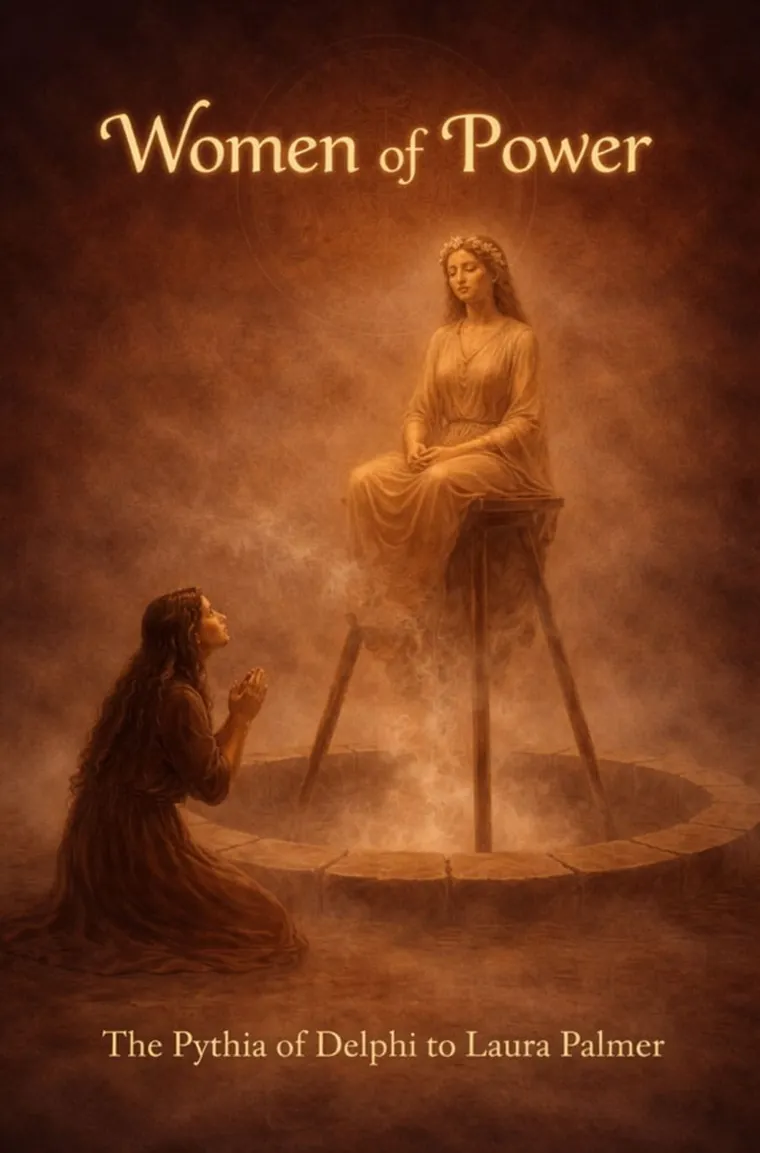
Serialisation of Women of Power. The Pythia of Delphi to Laura Palmer by Nigel Graddon. (With permission).
Chapter 1: The Mother of All
Every part of this earth is sacred to my people. Every shining pine needle, every sandy shore, every mist in the dark woods, every meadow, every humming insect. All are holy in the memory and experience of my people. We know the sap which courses through the trees as we know the blood that courses through our veins. We are part of the earth, and it is part of us. The perfumed flowers are our sisters. The bear, the deer, the great eagle, these are our brothers. The rocky crests, the juices in the meadow, the body heat of the pony, and man, all belong to the same family. The shining water that moves in the streams and rivers is not just water, but the blood of our ancesters. Each ghostly reflection in the clear water of the lakes tells of events and memories in the life of my people. The water’s murmur is the voice of my father’s father. The rivers are our brothers. They quench our thirst. They carry our canoes and feed our children. So, you must give to the rivers the kindness you would give your brother... Remember that the air is precious to us, that the air shares its spirit with all the life it supports. The wind that gave our grandfather his first breath also receives his last sigh. The wind also gives our children the spirit of life... Will you teach your children what we have taught our children? That the earth is our mother? … the earth does not belong to man; man belongs to the earth. All things are connected like the blood which unites us all. Man did not weave the web of life; he is merely a strand in it. Whatever he does to the web, he does to himself——Chief Seattle, 1855
Before the first temple, before the first word, there was form. Clay cupped in human hands became curves—hips, breasts, bellies—and the earliest art humanity ever made was not of men, beasts or weapons, but of women.
The persistence of the Mother Goddess motif reveals something deeper than religion: it discloses an enduring human intuition about power. Male divinities might command storms or thrones, but the feminine divine embodied transformation. Her strength was cyclical, not linear; generative, not coercive. The Mother Goddess thus offered a model of power grounded in creation—a kind of authority that produces rather than subdues. To trace her history is to follow humanity’s evolving relationship with nature, the body and the sacred itself.
In the Neolithic imagination, fertility was not only biological but cosmic. The sowing of seeds mirrored human conception, both acts dependent on hidden mysteries of time and transformation. Death itself was a return to the mother: the buried body rejoined the soil that would nourish future life. The grave and the womb were sisters. Such metaphors shaped the earliest rituals, in which planting, birthing and mourning were aligned acts of reverence.
The continuity between woman and world established by these myths would persist, even as civilisations rose and codified their deities into hierarchies. The Great Mother might gain names and faces, but her essence—the unity of matter and spirit—remained the same.
Up to approximately 4,000 years ago the feminine principle, represented in mythological life as “the goddess” and in culture as the qualities of spontaneity, feeling, instinct and intuition, was a vital expression of the sanctity of life. Today, there are few indications of the feminine dimension of the divine, even in our “New Age” times. This woeful omission is a product of humanity’s choice to structure global cultures in the image of a masculine god who is beyond creation, not within creation, as were the mother goddesses before him. This has resulted in an imbalance of the masculine and feminine principles, which has fundamental implications for how we create and maintain a positive perspective upon our world and how we live in it.
The religious images in the present day are those of the father god who created heaven and earth through his word, so that he is beyond his creation, not within it. As a reflection of this imbalance, we have become increasingly used to a mythological tradition in which nature—the earth, the animals, seas, rivers, birds and mountains—is not sacred.
However, an underlying belief in the unity and sacredness of life has lived in the roots of the human psyche for far longer than the negative mutations of religious thought. Formal religions tend to dismiss as animism the feelings of people for whom nature is truly alive. They also largely ignore contemporary psychological discoveries, especially those of Jung which show that the knowledge of all the human race is stored within the psyche and so is potentially available to every one of us.
The story of the Goddess is very powerful. She reigned supreme long before Christianity. Approximate to the time of the final Atlantean cataclysm, circa 10,000 bce, the last Cro-Magnon wave of settlers in the form of the Magdalenian culture arrived in Britain across the relatively recently formed channel that had flooded the land bridge to the European Continent. These culturally developed incomers were skilled in hunting and in the making of prehistoric art. They included the Nemeans and Melasians from Greece, the Formorians from Iberia (Spain), and, later, beginning around 2,800 bce, the Beaker people, a complex culture rich in shared ideological, cultural and religious ideas with skills in precious metalwork, archery and ornamental work. Next came the Phœnicians, the greatest traders in their day who arrived in long-oared galleys to procure tin from Britons.
Arguably, one of the biggest upheavals came with the arrival of the Celts, whose beginnings can be traced back approximately 3,300 years to the Urnfield culture of central Europe. Nevertheless, it was not until around 800 bce that the first people to adopt distinctly cultural characteristics that are regarded as Celt appeared in central Europe, particularly in Austria, an area often called the “Celtic homeland.”
In their early history the Celts first occupied an area between the upper reaches of the rivers Elbe, Danube and Rhine, spreading into northern Italy around 2,500 years ago. Subsequently, over a 300-year period beginning around 450 bce the Celts (or Kelts) spread rapidly over the European continent; the Romans called them Gauls.
During this latter period the Celts sacked Rome (387 bce), plundered the treasures of Delphi in Greece, and populated Spain, Britain and Ireland. Written evidence that could throw light on the development of the Celtic language, spoken today mainly in Brittany in France, Ireland, Scotland, Wales, Cornwall and the Isle of Man, is scarce as the early Celts preferred word-of-mouth communications.
The Celts’ primal deity was the earth goddess, the Mother who was known by many names according to different sites with which she was associated. One such was Minerva, known in Britain as Brighd or Brigit and who represented the virgin aspect of the Great Goddess. In Aqua Sulis (modern day English city of Bath) a perpetual fire was maintained in honour of Minerva. Brighd, a goddess of poetry and divine inspiration, was the patroness of the celebrated Druid bard, Taliesin.
Nigel Pennick[1] wrote of the Celtic bards, who saw no distinction between history and mythology and held a poetic vision of the landscape, a realm ensouled with spirits. Mother Earth was the goddess of the landscape, both the genius loci, the spirit of the place, and the anima loci, the soul-place, the essential personality of a location where the unseen may be brought into physical presence if one has a loving, neutral, non-judgmental relationship with nature.
The forces of living nature may be sensed as a presence or being that exists beyond the everyday realms of human cognizance, possessing its own consciousness and personality. The philosophers of old recognised this very clearly. Aristotle, for example, expressed it beautifully:
We say that the Sensible World is an image of another; therefore, since this world is vivid or alive, how much more, then, that other must live... Yonder, therefore, above the stellar virtues, stand other heavens to be attained, like the heavens of this world; beyond them, because they are of a higher kind, brighter and vaster; nor are they distant from each other like this one, for they are incorporeal. Yonder, too, exists an earth, not of inanimate matter, but vivid with animal life and all natural terrestrial phenomena like this one, but of other kinds and perfections. There are plants, also, and gardens, and flowing water; there are aquatic animals but of nobler species. Yonder is air and life appropriate to it, all immortal. And although the life there is analogous to ours, yet it is nobler, seeing that it is intellectual, perpetual and unalterable.
Pennick described the Celtic world-system, symbolised as three circles or worlds and viewed as concentric circles or ascending planes upon the column of the world tree. The idea of a world tree or cosmic axis tells of a vertical axis that runs through this physical plane, linking us to other planes of existence, their vibratory rates increasing as one ascends the axis, or decreasing as one descends to the lower interconnecting planes.
Cylch y Abred, the middle earth on which we walk, the realm of the ego, stands above the underworld, the Celtic “Annwn,” realm of the unconscious and the incorporeal abode of unformed matter, wraiths and demonic spirits. Above is Cylch y Gwynvyd, the heavenly upperworld abode of enlightened divine beings and those humans who have transcended the cycles of their earthly lives; and, highest, is Cylch y Ceugant, the ineffable place of Hen Ddihenydd, the “Ancient and Unoriginated One,” the unattainable sole abode of God of the monotheistic system.
Ancient teachings inform us that the earth is not a dead body but is infused by a spirit that is its life and soul. Natural places such as stones, springs, mountains, islands and trees are ensouled locations where the anima loci may be best experienced in elevated consciousness, where we can receive religious or mystical inspiration and be most receptive to healing body and mind. They become powerful indicators of metaphysical realities in which the reward is to experience revelations of the archetypal qualities of an eternal otherworld—paradise. Enhancing the anima loci is akin to spiritual gardening in which participating consciously in Nature induces an ennobling presence in the observer.
Traditional cultures held that all existence is pervaded by a subtle cosmic breath which animates all things and empowers their continued existence. In the West this magical breath is the pneuma or the fifth Platonic element, the Quintessence. The Welsh bards called it anal or anadyl. In the Celtic belief system, the realms of animals, humans, gods and goddesses, Nature Spirits, life and death are not separate. Together, they are simply the one magnificent world of natural existence, a great integrated continuum in which everything is a harmonious element of the whole.
Classical Pagan belief held that man is made in the image of God and in the image of the Universe. Gregory Nazianzene, 4th-century Archbishop of Constantinople, said that ‘Every creature, both of heaven and earth, is in man,’ illustrating that the workings of the human body and soul are reflections of the universe.
This vital connection between nature and the nature of human beings is represented by The Book of Llanrwst, attributed to the Bard Taliesin:
There are eight parts in man. The first is the earth, which is inert and heavy, and from it proceeds the flesh; the second are the stones, which are hard, and the substance of the bones; the third is water, which is moist and cold, and is the substance of the blood; the fourth is the salt, which is briny and sharp, and from it are the nerves, and the temperament of feeling, as regards bodily sense and faculty; the fifth is the firmament or wind, out of which proceeds the breathing; the sixth is the sun, which is clear and fair, and from it proceed the fire, or bodily heat, the light and colour; the seventh is the Holy Ghost, from whom issues the soul and life; and the eighth is Christ, that is, the intellect, wisdom and the light of soul and life.
According to pagan belief, when we die our physical bodies return to Mother Earth. In northern Europe, tradition had it that the souls of the dead go into the hills and spirit-mountains, where they dwell with other otherworldly beings.
The custom of interring the dead and their goods in earth mounds was common among the Celts who believed that in burying in this manner those that had passed created a model of the otherworld. They regarded the otherworld as a symbolic realm in which everything must be carried out correctly, according to universal principles that reflect the underlying orderly structure of existence. Those whose remains go into the earth leave the world of the living and re-enter the womb of Mother Earth from whom they emerged at the time of birth. At death, part of the human spirit goes into the otherworld to be regenerated and reborn; their goods are taken into the fairy kingdom; and the burial mound serves as a memorial to the life and deeds of the departed.
As Baring and Cashford[2] astutely point out, whereas history as a true record of the past has been told almost entirely in terms of its outer eventfulness, its role as a reflector of the nurturing of the human spirit and societies’ inner qualities has been radically downplayed. The most neglectful aspect of this phenomenon is the way the feminine half of the human spirit has been wholly downgraded by masculine-dominated societies. As a consequence, we see today an increasing decay of the caring values of life at the same time as global society wilfully pursues choices and policies driven by male dominance. This loss of feminine eventfulness has led inexorably to the exploitation and rejection of our Mother Earth, in olden days symbolised by the Mother Goddess.
The Mother Goddess, as a symbolic icon of worship and veneration, is an image that focuses and inspires a perception of the universe as an organic, sacred and sentient whole in which humanity, the Earth and all life on it participate as “her children.” Everything is woven together in one cosmic web, where all orders of physical and spiritual life (the manifest and the unmanifest) are related, because all share in the sanctity of the original source.
Ours is the age above all others that has removed the essence of sacredness from nature. It seems from the evidence of increasing pollution (itself a term that originally meant the profaning of what was sacred) that humanity no longer enjoys instinctively the profound feeling that the Earth is a living being. As a consequence, the whole body of the Earth is threatened in a way unique to the history of the planet.
The Neolithic period (10,000 to 5,500 bce) was the great age of discovery, which saw mankind enjoying a new relationship to the universe. This was the time when humanity truly learned to participate in the mysterious processes of growing. With the realisation that certain seeds changed into wheat and corn, which could be transformed into bread, and that certain animals would live close to the home and provide milk, eggs and meat, a new spirit of conscious co-operation between human beings and their world took shape. Nigel Pennick described beautifully early man’s symbiotic relationship with Mother Earth:[3]
Like the animal kingdom, early man was integrated with the environment, occupying his niche in a completetely natural and unconscious manner. His life was controlled by the passage of the seasons, his nomadic wanderings directed by necessity. The faculty of intuition was his guiding principle. It led him to find water, nourishment and shelter... His symbiotic relationship with the “ecosystem” was not yet broken. Possessing intelligence, he recognized his dependence upon Mother Earth, who had brought him into being and sustained him. She was the universal deity. Each part of her was therefore sacred, suffused with her spirit and manifest in different forms according to the place. The various powers present in rocks were operative and available at the appropriate times. To such people, any alteration of the earth was an unthinkable sacrilege... Ancient peoples were able directly to experience the energies in the earth and attributed them to the activity of the earth spirit. The places where they occurred became sites of special reverence, later to be incorporated as the active sites in sacred buildings... A natural reverence, alien to the modern spirit, guarded and nurtured these sites where anyone could experience his or her own direct magical relationship with the essential nature of the earth.
This expression of consciousness in the Neolithic was explored through the medium of the goddess. The Mother Goddess presided over the whole of creation as goddess of life, death and regeneration, containing within herself the life of plants as well as the life of animals and human beings. Equally, there was the same recognition of a dynamic relationship between an invisible cosmic order that governed the revolving phases of the moon, and a visible earthly order in the cycles of human and animal life, and the seasons and the agricultural year.
As the great light shining in the darkness of the night, the moon, in all mythologies up to the Iron Age (c. 1,250 bce), was regarded as one of the supreme images of the Goddess, who was the measure of the cycles of time and of cosmic and earthly connection. Duality, symbolised as the waxing and waning moon, was contained and transcended in her. Analogously, life and death did not have to be perceived as opposities but could be seen as phases succeeding each other in eternal rhythm. Similarly, she governed the fertility of women, the waters of the seas and the phases of increase and decrease. The seasons followed each other in sequence as the phases of the moon followed each other. The Goddess was an enduring image of the renewal of time because what appeared to be lost with the waning moon was restored with the waxing moon.
Neolithic pottery depicts the mystery of birth through the body of the goddess. Images show her as the portal through which lives enter and leave this world. Figures often show her adorned on her front and back with a labyrinth or similar meander design, symbolizing the goddess as the vessel that is the gateway to the dimension beyond human life.
The Goddess in all her manifestations was the symbol of the unity of all life in Nature. Her power was in the water and stone, in tomb and cave, in animals and birds, snakes and fish, trees and flowers. Hence the holistic and mythopoeic perception of the sacredness and mystery of all there is on Earth.
The concept of a “standalone” male god in the Neolithic era was largely unknown. The male influence existed only within the Goddess. In Crete, for example, the male aspect of the goddess, an androgynous all-powerful deity uniting both male and female roles, was symbolized by the crescent horns of the bull or by a male animal: bull, ram or stag.
Later, in the Bronze Age (c.3,300 - 1,200 bce) the male in the Minoan belief system had to some extent separated from the Goddess but was not yet independent of her. This is evidenced by archaeological examination of seals and carvings in which the representation of the masculine and feminine principles is seen as an image of the great goddess and a young god, which is never shown as a male that has advanced beyond childhood. Instead, when the young god and the mother goddess are depicted together, the relation is not one of equal power-sharing between an adult god and an adult goddess, but one of service by a young god paying homage to the Mother Goddess.
In Neolithic belief, the god was the “son” of the goddess, a relationship that personified the forces of growth, which, like flowers and trees, die an annual death into the body of the goddess in order to be reborn from her the following spring. In this way, the young god symbolises the form of life that has to change, while the goddess remains as the principle of life that never dies and continually renews itself through its myriad changing forms.
In Minoan culture the all-supreme Goddess was not known by a particular name but was simply regarded as the eternal power of life, death and regeneration. Elsewhere in the Bronze Age era, the great goddesses of the day were given names, as in Sumeria, Egypt and Anatolia, for example. Their three great goddesses were Innana (or Ishtar as she was called in northern Sumeria), Isis and Cybele respectively. All three reflect the image of the Great Mother who presided over the earliest civilisations that arose between Europe and the Indian subcontinent.
This was a period when nature was still experienced as numinous: a divine force that is both sacred and alive. It was seen in the sun’s rays, in the river’s rise and fall, in the twinkling stars of heaven, in the violence of floodwaters, in the green shoots of cereals crops, and in the grapes of the vine. Similarly, its mysterious energies were perceived in the attraction of male and female, in health and disease, and in life and death. These phenomena revealed to humanity not so much that the divine is everywhere but that the divine is everything.
In Sumerian cosmology the Mother Goddess, Ki-Ninhursag, was the mother of all living, of the gods and of humanity, mother of the earth itself, the soil and the rocky ground, and all the plants and crops it brought forth. She was the Holy Shepherdess, Queen of Stall and Fold.
Later she was personified by Inanna, Great Mother, Virgin Queen of Heaven and Earth, Holy Shepherdess, Light of the World, Moon Goddess and Morning and Evening Star. She said, ‘I step onto the heavens, and the rain rains down; I step onto the earth, and grass and herbs sprout up.’ Inanna was clothed with the heavens and crowned with the stars, her lapis crystal jewels reflecting the blue of the sky and the blue of the waters of space that the Sumerians named “The Deep.” She wore the rainbow as her necklace and the zodiac as her girdle. Innana was truly Mother Nature in all her power and glory. She is also known as “The Green One, she of the springing verdure,” after the green corn that the earth wears as her mantle in spring. Inanna carries on her head the lunar horns, which proclaim her to be the descendant of the ancient goddess who originally was the sky, earth and underworld. Her cult endured for 4000 years.
The myth of Ishtar and Tammuz, esoteric god of the sun and one of the guardians of the gates of the underworld, is one of the earliest examples of the dying-God allegory. According to the myth, Tammuz was killed every year by a wild boar but was rescued from the nether world by Ishtar, who descended into the underworld in search for the sacred elixir which alone could restore Tammuz to life.
Acclaimed mystical-metaphysical philosopher Manly P. Hall (1901-1990) relates the story of Ishtar’s mission to rescue her lover.[4] With outspread wings, Ishtar, the daughter of Sin (the Moon), sweeps downward to the gates of death. The house of darkness—the dwelling of the god Irkalla—is described as “the place of no return.” It is without light; the nourishment of those who dwell therein is dust, and their food is mud. Over the bolts on the door of the house of Irkalla is scattered dust, and the keepers of the house are covered with feathers like birds. Ishtar demands that the keepers open the gates, otherwise she will shatter the doorposts and strike the hinges and raise up dead devourers of the living. The guardians of the gates beg her to be patient while they go to the queen of Hades from whom they secure permission to admit Ishtar, but only in the same manner as all others came to this dreary house.
Ishtar thereupon descends through the seven gates which lead downward into the depths of the underworld. At the first gate the great crown is removed from her head, at the second gate the earrings from her ears, at the third the necklace from her neck, at the fourth the ornaments from her breast, at the fifth the girdle from her waist, at the sixth the bracelets from her hands and feet, and at the seventh gate the covering cloak of her body. Ishtar remonstrates as each successive article of apparel is taken from her, but the guardian tells her that this is the experience of all who enter the sombre domain of death. Enraged upon beholding Ishtar, the Mistress of Hades inflicts upon her all manner of disease and imprisons her in the underworld. As Ishtar represents the spirit of fertility, her loss prevents the ripening of the crops and the maturing of all life upon the earth. In this respect the story parallels the Greek legend of Persephone.
The gods, realising that the loss of Ishtar is disorganizing all Nature, send a messenger to the underworld and demand her release. The Mistress of Hades is forced to comply, and the water of life is poured over Ishtar. Thus, cured of the infirmities inflicted on her, Ishtar retraces her way upward through the seven gates, at each of which she is reinvested with the article of apparel which the guardians had removed.
The myth of Ishtar symbolizes the descent of the human spirit through the seven worlds, or spheres, of the sacred planets until, finally deprived of its spiritual adornments, it incarnates in the physical body—Hades—where the mistress of that body heaps every form of sorrow and misery upon the imprisoned consciousness. The waters of life—the secret doctrine of the Ancient Wisdoms—cure the diseases of ignorance; and the spirit, re-ascending to its divine source, regains its God-given adornments as it passes upward through the rings of the planets.
It is generally agreed that the Greek cult of Athena, goddess of war and handicraft, was influenced by those of Inanna and Ishtar, all three being associated with creation. Athena particularly resembles Inanna in her role as a terrifying warrior goddess. It is believed that Athena’s birth from the head of Zeus may derive from the earlier Sumerian myth of Inanna’s descent into and return from the Underworld.
Egypt’s foremost female deity was Isis, Queen of Heaven, Earth and the Underworld, worshiped from before 3,000 bce to the second century ce, after which Isis was metamorphosed into the Virgin Mary because, although she gave birth to all living things, she remained a virgin.
Isis is, in fact, the female principle of Nature, and is receptive of every form of generation, in accord with which she is called by Plato the gentle nurse and the all-receptive, and by most people has been called by countless names, since, because of the force of Reason, she turns herself to this thing or that and is receptive of all manner of shapes and forms. She has an innate love for the first and most dominant of all things, which is identical with the good, and this she yearns for and pursues; but the portion which comes from evil she tries to avoid and to reject, for she serves them both as a place and means of growth, but inclines always towards the better and offers to it opportunity to create from her and to impregnate her with effluxes and likenesses in which she rejoices and is glad that she is made pregnant and teeming with these creations. For creation is the image of being in matter, and the thing created is a picture of reality.
Apuleius in The Golden Ass ascribes to Isis, she of the ten thousand appellations, her self-declared statement concerning her powers, which clearly identify her as Mother Earth, Goddess without equal:
Behold, I, moved by thy prayers, am present with thee; I, who am Nature, the parent of things, the queen of all the elements, the primordial progeny of ages, the supreme of Divinities, the sovereign of the spirits of the dead, the first of the celestials, and the uni-form resemblance of Gods and Goddesses. I, who rule by my nod the luminous summits of the heavens, the salubrious breezes of the sea, and the deplorable silences of the realms beneath and whose one divinity the whole orb of the earth venerates under a manifold form, by different rites and a variety of appellations... Minerva, Venus, Diana, Proserpine, Ceres, Junio, Hecate... And those who are illuminated by the incipient rays of that divinity the Sun, when he rises, call me by my true name, Queen Isis.
Augustus Le Plongeon (1825-1908), a British-American archeologist and photographer who studied the pre-Columbian ruins of America, believed that the Egyptian myth of Isis had a historical basis among the Mayans, to whom she was known as Queen Moo. He based this belief on the theory that Mayan civilisation was far older than that of Egypt. After the death of her husband, Prince Coh, Moo took refuge among the Mayan colonies in Egypt where she was accepted as their Queen and named Isis.
Isis is represented in the Song of Solomon by the dark maid of Jerusalem, symbolic of receptive Nature. In the story of Solomon and his wives, one reads an allegory in which Solomon is the sun and his wives are the planets, moons, asteroids and other heavenly bodies in his house, the solar mansion.
In statues of Isis can be seen a deep box filled with flaming coals and incense descending down a thread from a golden ring on her left arm. Isis, Nature personified, carries with her the sacred fire, religiously preserved and kept burning in a special temple by the Vestal Virgins. This fire is the genuine, immortal flame of Nature—ethereal, essential, the author of life. From the figure’s right arm also descends a thread, to the end of which is fastened a pair of scales, signifying the preciseness of Nature in her weights and measures.
The Druids of Britain greatly venerated Isis under her symbol of the moon. In Druid cosmology the sun was the father, and the moon, Isis, the mother of all things. By means of these powers, the Druids worshiped Universal Nature. Recognising the sun as the proxy of the Supreme Deity, the Druidic priests of Britain used a ray of solar light to spark their altar fires. They did this by concentrating the ray upon a specially cut crystal or aquamarine, set in the form of a magical brooch on the belt of the Arch-Druid. This brooch was called the “Liath Meisieith” and was reputed to possess the power of drawing the divine fire of the gods down from heaven and concentrating its energies for the service of men.
Crystal also featured in the Druids’ magical quest to travel to the blessed realm of Gwynedd, the world of the Twice-born. To achieve success, they first had to pass through three Veils, one of which, the Veil of Cythraul, was symbolised by Cwrwg Gwydrin, a glass (crystal) boat for travel to the in-between realms of the Otherworld.
In Israel, even though there is no word for Goddess in Hebrew, in Judaean cosmology Yahweh did not reign supreme. There is a hidden goddess in the Old Testament, seen in the Cherubim that adorn the Ark of the Covenant, and which represent the sister goddesses of Egypt, Isis and Nephthys, the winged beings protecting the Assyrian Tree of Life in Mesopotamia. The veil that protected Solomon’s Temple’s Holy of Holies was also woven with the same image.
The hidden Hebrew Goddess is also represented by the Canaanite Asherah (Mother of the Gods), by Anath (sister-wife of god Baal), Lady of Heaven and Mistress of all the Gods, by Astarte (Ashtoreth in Hebrew), and Hokhmah (in Greek, Sophia), the invisible unnamed consort of Yahweh, the master transcendent craftswoman of creation, the “Wisdom.” Later came Mary, in Church dogma Mother of God, Perpetually Virgin, Immaculately Conceived, and Assumed into Heaven, Body and Soul, where she reigns as Queen.
As the Bronze Age reaches its final millenium, its culture changes. The Mother Godddess starts to recede into the background as father gods begin to move centre-stage. Gradually, she loses her capacity to inspire, and the male force assumes an increasingly dynamic role in which the Father God occupies front and centre.
The once powerful myth of the separation between Heaven and Earth is to become the foundation of Iron Age theologies in which humanity is set apart from nature. Increasingly, humans act reflectively rather than instinctively, which commences a dissociation from the instinctive life of nature and instils the temptation in man to call the goddess (nature) “lower” and the god (spirit) “higher.”
One may only speculate on how the goddess cultures of the Bronze Age would have maintained precedence had they not been disrupted by the arrival of warrior tribesmen (principally the Semites from the Syro-Arabian deserts, and what would evolve into the Hellenic-Aryan races from the plains of Europe and south Russia), who imposed their mythology and patriarchal customs on those they invaded. The impact on the Bronze Age goddess cultures from Europe to India was profound.
After a long struggle, in 1,750 bce cities to the north of Sumeria— Nippur, Akkad, Sippar, Kush and Babylon—gained supremacy over their southern neighbours. Consequently, Inanna’s Babylonian counterpart, Ishtar, inherited her imagery and ritual drama.
Towards the close of the Age of Bronze and with the dawn of the Iron Age, the old cosmology and mythologies of the goddess mother were radically transformed, reinterpreted, and in large measure even suppressed, by these suddenly intrusive patriarchal warrior tribesmen whose traditions have come down to us chiefly in the Old and New Testaments and in the myths of Greece.
Two extensive geographical matrices were the source lands of these insurgent warrior waves: for the Semites, the Syro-Arabia deserst, where, as ranging nomads, they herded sheep and goats and later mastered the camel, and, for the Hellenic-Aryan stems, the broad plains of Europe and south Russia, where they had grazed their herds of cattle and early mastered the horse. Both invading forces introducd the idea of an opposition between the powers of light and darkness, in contrast to the former prevailing belief in which the whole contains both light and darkness in an ever-changing relationship.
Increasingly, there arose a desacralisation of nature and human life, very much at odds with the instinctive attitude of the Neolithic farmer who lived close to the soil and perceived the rhythmic laws of the goddess as inherent in all life. Eventually, the feminine-centric cosmology of the settled agriculturalists was undermined, and a pattern of war and conflict was established in the Near East that endures to the present day.
Additionally, in another crucial change in consciousness a new attitude to death appeared around 2,500 bce, in which physical decease came to be regarded as the absolute end and opposite of life. The lunar (goddess), cyclical concept of death and rebirth no longer prevailed; darkness was now associated with what was not light or life.
Death became something final, and terrifying, without the promise of rebirth. The profound implications of this new and brutal cosmology were reflected in the remarkable increases in bloodshed and war, in which it seemed that the constant celebration of the killing of the enemy can be explained psychologically only through the concept of ritual sacrifice.
The tribes that conquered Sumeria brought with them their sky gods. Subsequently, the resultant trinity became the gods An, Enlil, and Enki, out of which Enlil, the god of air, whose city was Nippur, gradually rose to prominence. A major consequence was that Ki, Mother Earth, could no longer be worshiped and adored as the mother of Enlil; instead, she was conceived by Sumeria’s theologians as Enlil’s big sister, suggesting that her role as Mother Earth was usurped by Enlil and, thus, it came about that the god as son evolved into God as father.
The Iron Age saw the culmination of the process by which the numinous forces of living nature—the Mother Goddess—were transferred to the Father God, who gradually evolved in human perception into the consortless God of the three patriarchal religions known to us today: Judaism, Christianity and Islam. From this time forward, the male god is the sole primal creator, completely usurping the goddess as the only source of life.
However, this process generated a god who is weaker in power and numinosity than the Goddess because he has only become the maker of heaven and earth, whereas the goddess was heaven and earth, the creations emerging from her being part of her, and she of them. Henceforth, the essential identity between creator and creation was broken, and a profound sense of dualism—spirit and nature—prevailed, a totally alien concept in Goddess mythology, which recognised no separation between them. From then on, the mythic model of the new culture, ruled by a zealous, male Father God, is one of mastery and control, expressing the desire to shape and order what had been created.
Despite the birth of religion movements that worshiped only the patriarchal principle, humanity understood deep within its collective psyche that the emergence of the Father God had brought forward a deity that was intrinsically less appealing and far less cosmically and spiritually substantial than the Mother Goddess.
Patriarchal suppression never fully erased her. Within the new structures of faith, the old goddess adapted. In Christianity, she reappeared as Mary, the Virgin Mother whose paradox—purity and maternity united—encoded the old mysteries in new form. Her titles, Regina Coeli and Mater Dolorosa, echo Isis’s epithets. The medieval cult of Mary restored tenderness to the divine, softening the paternal severity of heaven with the compassion of a mother. Cathedrals dedicated to Notre Dame became urban mountains—architectural tributes to the feminine as shelter and source.
As late as the fourth century it seemed probable to an observer that if the Roman Empire survived, a religious consensus would prevail based on the worship of the universal Great Mother. Lyons was already the city of Cybele by the third century. In Paris, the rule of Isis was especially strong. She reigned in the city until Saint Genevieve took over as patroness in the sixth century. A writer called Jacques leGrand, writing in about the 1400s, recorded this Isis-Paris connection:
In the days of Charlemagne... there was a city named Iseos, so named because of the goddess Isis who was venerated there. Now it is called Melun [about an hour south of Paris.] Paris owes its name to the same circumstances. Parisius is said to be similar to Iseos because it is located on the river Seine in the same manner as Melun.
Nevertheless, the Christian Church that Constantine established became strongly patriarchal with the growing emphasis on the martyr qualities of defiant steadfastness and simple faith of Christian soldiers, rather than subtler, gentler qualities. Judaeo-Christian religion or mythology (depending on one’s point of vew) had inherited the paradigm images of Babylonian mythology, particularly the opposition between Creative Spirit and Chaotic Nature, and also the habit of thinking in oppositions, especially in a common assumption that the spiritual and the physical worlds are different in kind, an opinion that separates mind from matter, soul from body, thinking from feeling, intellect from intuition, and reason from instinct.
Despite humanity’s psychic recognition that the Goddess is a vital part of mankind’s evolutionary journey through the classrooms of the physical experience, Christian patriarchy spared no efforts in seeking to bury any re-emergence of the mysticism and magic of the Goddess and her priestess representative, the Sacred Prostitute.
In the twelfth century the Church carried out its most brutal stage of its feminine-principal extermination programme with the advent of the Albigensian Crusade. The courts of the Inquisition replaced the courts of the Minne—courtly love—with mass torture. Millions were killed, the vast majority being women. But the Church’s goal of total extinction of the Goddess was always doomed to fail because the “Mother” is a holy and eternal force that is resident in all of nature, including in the hearts and minds of those that would have her killed, rather than have to give up the illusory and temporal trappings of masculine “superiority.”
The Goddess as an archetypal constant cannot be killed. If that were possible then the entire human race would become tremendously imbalanced because we are a dualist creation. Women have an outer female self centred round the spiritual qualities of conception, incubation, birth and nurturing, which is balanced by the projective and guardian qualities of an inner male self. The converse is true in males. All of the Ancient Wisdoms and master philosophers taught this truth.
A fundamental part of one’s refreshment of the immortal goddess energies that exist within, is to constantly re-charge and re-generate them through maintaining a loving relationship with Mother Nature, a practice that is an individual action and responsibility. Russell described in The Candle of Vision his experiences in communing with Mother Earth:
I must in some fashion indicate the nature of the visions which led me to believe with Plato that the earth is not at all what the geographers suppose it to be, and that we live like frogs at the bottom of a marsh knowing nothing of that Many-Coloured Earth which is superior to this we know, yet related to it as soul to body. On that Many-Coloured Earth, he tells us, live a divine folk, and there are temples wherein the gods [and goddesses] do truly dwell, and I wish to convey, so far as words may, how some apparitions of that ancient beauty came to me in wood or on hillside or by the shores of the western sea. Sometimes lying on the hillside with the eyes of the body shut as in sleep I could see valleys and hills, lustrous as a jewel, where all was self-shining, the colours brighter and purer, yet making a softer harmony together than the colours of the world I know. The winds sparkled as they blew hither and thither, yet far distances were clear through that glowing air. What was far off was precise as what was near, and the will to see hurried me to what I desired. There, too, in that land I saw fountains as of luminous mist jetting from some hidden heart of power, and shining folk who passed into those fountains inhaled them and drew life from the magical air... Once I lay on the sand dunes by the western sea. The air seemed filled with melody. The motion of the wind made a continuous musical vibration. Now and then the silvery sound of bells broke on my ear. I saw nothing for a time. Then there was an intensity of light before my eyes like the flashing of sunlight through a crystal. It widened like the opening of a gate, and I saw the light was streaming from the heart of a glowing figure. Its body was pervaded with light as if sunfire rather than blood ran through its limbs. Light streams flowed from it. It moved over me along the winds, carrying a harp, and there was a circling of golden hair that swept across the strings. Birds flew about it, and over the brows was a fiery plumage as of wings of outspread flame. On the face was an ecstasy of beauty and immortal youth... and I knew the Golden Age was all about me, and it was we who had been blind to it but that it had never passed away from the world.
Across millennia, the Mother Goddess has been reborn countless times. She embodies a truth both biological and metaphysical: that existence is relational, cyclical, and self-renewing. In her myth we find not only the story of women but of the world. When cultures honour her, they tend to honour the Earth; when they suppress her, they often exploit it. The pattern is unmistakable.
To speak of the Mother Goddess today is not to regress into superstition but to recover perspective. She reminds us that wisdom is not conquest but comprehension; that strength lies in sustaining; that every act of destruction is, in mythic terms, matricide. Whether as metaphor or as deity, she remains the conscience of civilisation—the embodiment of what human arrogance forgets.
The persistence of her image across time suggests that she is less a projection than a reflection: a mirror in which humanity recognises its dependence on forces beyond control. The goddess’s story, then, is also our own: the story of how power becomes care, how creation becomes responsibility, and how reverence becomes knowledge.
When the ancients shaped their first idols, they did not yet have language for philosophy or theology. They had only the experience of wonder—of birth, growth, and death returning into birth again. The Mother Goddess was their articulation of awe, their way of giving thanks to the mystery that sustains being. Thousands of years later, amid machines and cities, that mystery remains.
We still live within her body—the biosphere that breathes and feeds us. We still depend on her patience, still wound and heal her with our choices. In moments of crisis, her image rises again: a reminder that creation is not separate from compassion, that to care for the Earth is to honour the oldest divinity we know.
She is not past; she is process. She is not myth; she is metaphor made matter. Whether we call her Gaia, Nature, or simply Life, the Mother endures because we do. And perhaps that endurance is her final revelation: that every birth, every poem, every act of renewal, however small, is her worship continued.
[1] Pennick, N., Celtic Sacred Landscapes, Thames & Hudson, 1996.
[2] Baring, A; Cashford, J., The Myth of the Goddess: Evolution of an Image, Penguin Books Ltd., 1991
[3] Pennick, N., The Ancient Science of Geomancy, Thames and Hudson, 1979
[4] Hall, M., The Secret Teachings of all Ages, Philosophical Research Society, 1928
Book to be published October 2026