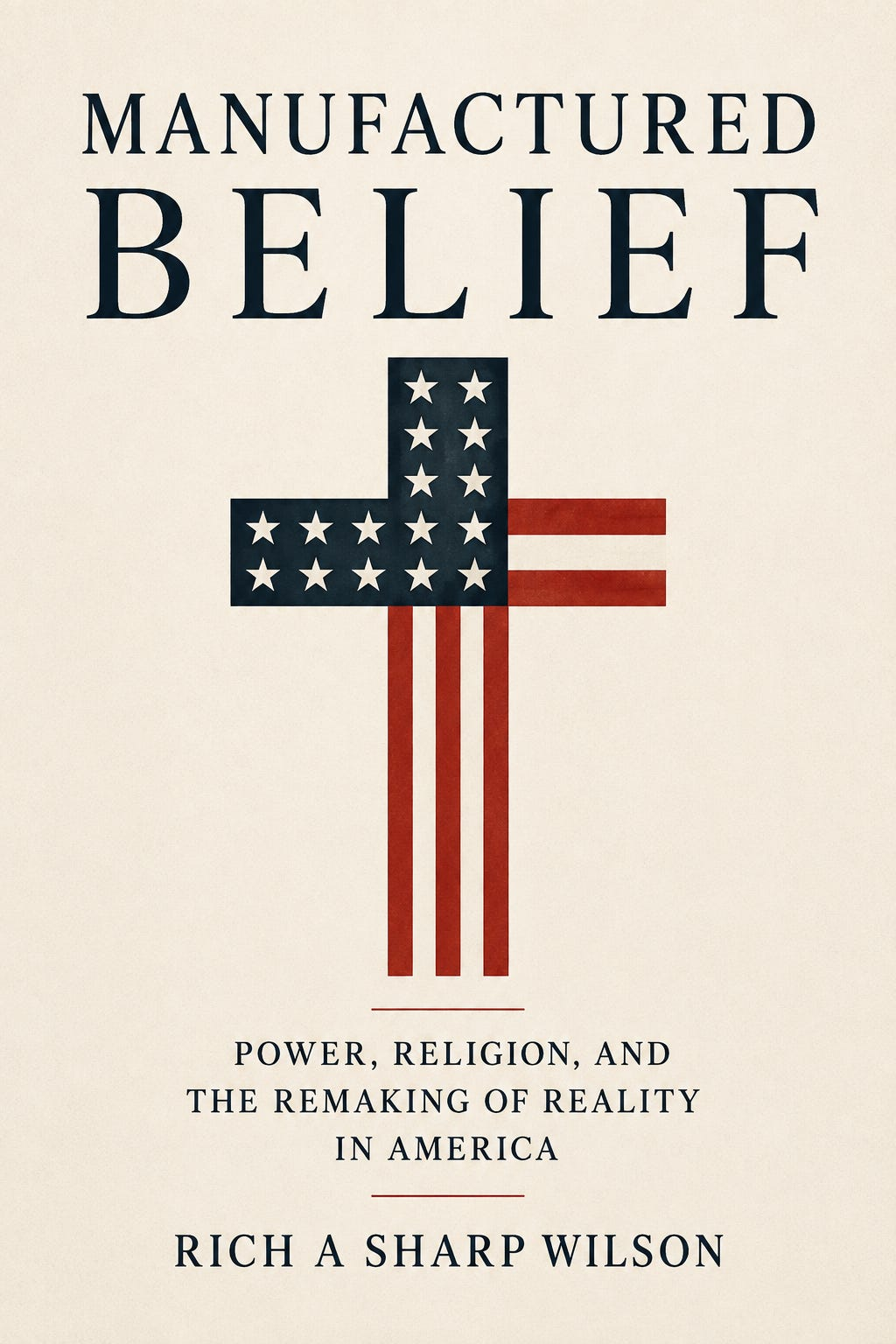

Power, Religion, and the Remaking of Reality in America
Rich A Sharp Wilson’s Manufactured Belief is an ambitious, provocative and strikingly readable attempt to answer a question that has become increasingly difficult to avoid: what happens when political disagreement stops being a contest over ideas and becomes a contest over reality itself?
Wilson begins with Christian nationalism in the United States, but the book quickly becomes something larger. Its real subject is belief: how stories become identities, how identities harden into systems, how those systems acquire institutions and media machinery, and how the machinery eventually starts telling people not simply what to think, but what counts as true in the first place.
Trump, MAGA and the American religious right are central case studies, but Wilson is less interested in producing another chronological tour through recent US politics. There are already enough books doing that to construct a modest retaining wall. His concern is the mechanism underneath: how belief is built, reinforced, defended and made resistant to contradiction.That is the book’s great strength.
Manufactured Belief keeps pulling the camera backwards.The opening sections examine the myths America tells about itself, particularly the self-made nation, exceptionalism and the idea of a country with a providential role. From there Wilson moves into the psychology of closed belief systems, the transformation of belief into identity and the media structures that reinforce both. Later chapters follow those ideas into religion, law, education, family, elections and public power before the final section widens the argument again to social media, performance, loneliness, algorithmic culture and the erosion of shared reality.
It is a large canvas, but Wilson gives it a recognisable intellectual spine. His recurring argument is that political movements cannot be understood merely by cataloguing what their adherents believe. We also have to understand how those beliefs are produced, rewarded, performed and protected from contradiction.That shift matters. It moves the discussion away from simply pointing at a collection of alarming beliefs and asking how anyone could possibly believe them. Instead, Wilson asks what sort of machinery keeps those beliefs warm, fed and supplied with fresh batteries.That is where the book earns its coherence.
Wilson is also an unusually engaging guide through territory that could easily become dense. He describes his approach as ‘kitchen table philosophy’, and the phrase fits. The book draws openly on thinkers including Hannah Arendt, Roland Barthes, Jean Baudrillard, Guy Debord, Neil Postman and Leon Festinger, alongside writers and researchers on American religion and Christian nationalism, but it rarely feels like an academic seminar where someone has locked the door until everybody agrees on the meaning of simulacra.The theory is translated into everyday language and repeatedly brought back to recognisable experiences: scrolling, arguing, belonging, performing, choosing sides and trying to make sense of an information environment that never seems to switch off.
That translation is important because Wilson’s subject is not merely ideology. It is lived experience. It is the phone in the hand, the feed refreshing, the community reinforcing itself and the slow conversion of political belief into social identity.Humour helps enormously.Wilson can move from political theology to media theory and then puncture the abstraction with a joke, an aside or a deliberately ridiculous image. The irreverence is not ornamental. It gives the reader somewhere to breathe. A book about authoritarianism, propaganda, religious power and social fragmentation could become several hundred pages of intellectual weather warning. Wilson understands that occasionally somebody has to open a window.The humour also serves the argument. Inflated certainty, sacred authority and political theatre tend to look rather less majestic once somebody removes the velvet curtain and points at the plywood underneath.
Some of the most effective writing comes late in the book, when the argument expands beyond American Christian nationalism. The chapters on the feed, the performance of the self and loneliness connect political radicalisation to a broader human environment in which attention is commercialised, identity is continuously displayed and people can be permanently connected while becoming increasingly isolated.This is where Manufactured Belief develops its widest reach.The political movements Wilson examines do not exist in a sealed laboratory. They operate inside a culture already training people to perform identity, seek affirmation, fear exclusion and interpret attention as value. Politics enters that environment carrying flags, theology and grievance, but the sockets are already in the wall.
Whether readers accept every step of Wilson’s political analysis or not, this broader diagnosis gives the book significance beyond its immediate subject. The question stops being simply, ‘Why do these people believe this?’ and becomes something more uncomfortable: what kind of society are we building when certainty, identity and belonging are constantly being manufactured, measured and sold back to us?Most importantly, Manufactured Belief does not finish by replacing one certainty with another.
Its afterword returns to doubt, curiosity, conversation, friendship and the ability to live with complexity. That is a quietly important choice. Having spent much of the book examining systems that reward certainty and punish contradiction, Wilson does not respond by producing another laminated instruction sheet telling the reader what enlightened people are required to believe.
His final concern is not simply what people believe, but what happens to human beings when belonging requires enemies and certainty becomes more attractive than reality.The answer he offers is deliberately modest: remain capable of questioning the stories around you, including your own.
There is something almost unfashionable about that conclusion. Doubt does not perform particularly well online. Curiosity is difficult to monetise. ‘I might be wrong’ has never looked especially heroic on a campaign banner.But that is precisely Wilson’s point.Manufactured Belief is therefore more than a polemic. It is part political analysis, part cultural criticism and part philosophical essay, written with anger, humour and genuine curiosity about why people seek certainty in frightening times.
It wants readers not merely to disagree with a particular movement, but to notice the machinery through which belief becomes identity, identity becomes reality and reality becomes power.And once you have noticed the machinery, it becomes rather harder to pretend the noise is simply coming from somewhere else.A challenging, energetic and thought-provoking book, and one whose central questions extend far beyond the politics of the moment.
Bill Human aka Satirical Planet News