

Serialisation of Women of Power by Nigel Graddon (with permission).
Chapter 1 | Chapter 2
“She spoke, and the world bent itself around the shape of her words.”
We descend now to the place where the world first learned to listen. The air is heavy with the scent of laurel and stone; the mountain trembles beneath its crust. Here, in the sanctuary of Apollo, a woman sat above a cleft in the earth, inhaling the divine breath of the god. The smoke that rose from that fissure carried with it the secret architecture of destiny.
The Oracle of Delphi began in a form that may go back to 1400 bce, but the Oracle of Apollo as it is known today was established around the 8th century bce. It was originally a sanctuary dedicated to the earth goddess Gaia before being rededicated to Apollo, who took over the site with the arrival of priests from Delos.
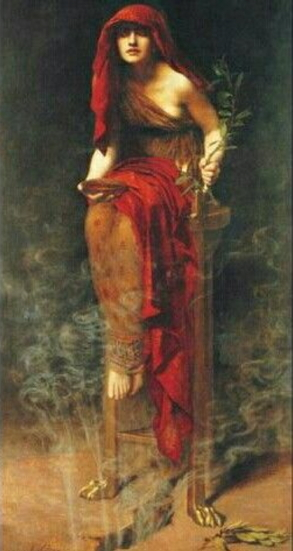
Every empire that sought counsel came to this awesome omphalos of the world, and from it spoke not conquest but ambiguity, the strange truth of language half-inspired and half-human. The Oracle at Delphi did not command—she revealed. Her power lay not in decree but in translation: the ability to voice what cannot be contained in ordinary speech.
In her, the sacred and the bodily were inseparable. The god’s spirit did not descend upon a statue or a flame but upon a living woman. Her utterance was both ecstasy and burden, her body the instrument through which the invisible sought form. She embodied a paradox that echoes throughout this work: the woman as the meeting point of revelation and peril.
To speak for the divine was to be consumed by it, and yet without her breath the message could not exist. The Pythia was the earliest articulation of the feminine as conduit, a being whose power came from surrender to something vast.
Around her gathered priests, interpreters and pilgrims from every land. They came bearing gifts of gold but what they sought was certainty, and what they received was always a riddle. The Oracle’s words demanded interpretation, compelling men of power to confront ambiguity. In this way, she undermined the absolute by speaking in the language of possibility. The woman of power thus begins her history not with domination but with mystery. She does not rule by force but by revelation, by the capacity to unsettle rather than to command.
The flame that the Vestals tended in Rome, the perpetual fire of Brigid in Ireland, even the electric shimmer around Laura Palmer—all descend from the same sacred essence that first breathed through the Pythia’s lungs. Delphi is the root of that lineage: a space where meaning itself was female. The smoke that curled upward became the first whisper of a supremely powerful metaphysical tradition, one that would echo through saints, queens, witches and visionaries for millennia. The Oracle’s voice, hovering between coherence and collapse, established the articulation and power of prophecy that later women would inherit—the rhythm of warning and renewal, the song of light emerging from darkness.
In the Pythoness’s presence we witness the birth of a pattern: the woman who carries the unbearable truth, who mediates between realms, who becomes both revered and feared for her gift. From the Delphic tripod to the electric hum of the modern screen, this figure endures because she embodies the oldest drama of consciousness—the human attempt to translate the infinite through the finite, to give voice to the unseen. The Oracle at Delphi is not only the beginning of this story; she is its eternal recurrence, the echo that reminds us that power, in its purest form, is always to be found in the act of listening.
The Breath of the Pythoness
There is a silence that breathes at the heart of the world, and in that silence, once, there spoke a woman who was not quite herself. Her name was not a name, but a title:Pythia, the Pythoness, the one who sat at the threshold between the mortal and the divine, her mouth shaping the words that were never hers to own. She sat in the navel of the world, the omphalos at Delphi where the stones seemed to hum with an ancient resonance, and where the air shimmered with the tension of things barely held apart: the seen and unseen, life and death, the question and the answer.
To speak of the Oracle is to enter that silence, to let one’s own words tremble on the verge of disappearance. For Delphi was not merely a place; it was a condition of being, a geography of consciousness that stretched between the mountain’s body and the human soul. The woman who served as Oracle entered this geography not as an observer but as a participant, her being dissolved and reconstituted in the presence of what the ancients called the god.
Apollo, radiant and cruel, god of prophecy and order, had slain the serpent Python, the chthonic guardian of this sacred site. From that act of conquest and transformation arose Delphi: a shrine that stood upon the bones of something older, darker and more fluid. The fumes that rose from the earth were the breath of the slain serpent, and those who inhaled them entered the state between worlds. The Oracle’s voice was, then, the sound of reconciliation—the voice of the earth itself, translated through human form, given language by a mouth that trembled under divine occupation.
It is tempting, in modern times, to imagine the Oracle as a mere priestess performing a role, a vessel for ritualised authority. But to reduce her to institution is to strip the mythic from the real. The ancients did not seek a woman who could memorise lines. They sought one who could stand in the abyss between self and other, and not break. In this role the Pythoness became what few can endure: a being transparent to the divine.
The sanctuary at Delphi was itself a living symbol of this mediation. The temple stood on the slopes of Mount Parnassus, near a fissure from which vapours emerged—what Plutarch later described as a “sweet and divine exhalation.” Whether or not such vapours truly existed is almost beside the point; what mattered was that the ancients believed the earth breathed, that it exhaled messages if one only knew how to listen. And listening required the annihilation of ordinary hearing.
The Pythia’s ritual prepared her for that. She bathed in the waters of Castalia, purified herself with laurel leaves and barley meal, then took her seat upon the sacred tripod above the chasm. Laurel smoke, the scent of Apollo, wreathed her face. As she inhaled, her consciousness became less distinct. The words that left her lips were fragmented, sometimes incoherent, yet always radiant with a pattern beyond logic.
Her attendants, male priests of Apollo, would interpret and arrange these utterances into hexameters, the language of prophecy. But the true oracle was not the verse; it was the breath before the verse, the threshold moment in which the human gave way to the divine.
This is what the ancients meant when they said that the Oracle “spoke with the voice of Apollo.” It was not that Apollo dictated sentences; rather, the god’s essence resonated through her being, shaping her utterance like wind through a lyre. The woman herself was the instrument, and the sound was the meeting point of worlds.
And yet, her role was paradoxical. She possessed no political power in the ordinary sense; she did not decree, nor did she command. Her authority was of a deeper, more disturbing kind—one rooted in the surrender of self. The very act of speaking as Apollo made her both sacred and terrifying. She was revered as the voice of light and feared as the echo of darkness. When she spoke, she drew from the well beneath order, from the serpent’s shadow that Apollo had conquered.
When we place the Oracle among the women of power, it is not because she ruled by decree, nor because she wielded armies or wealth. Her power was of another order, the kind that dissolves boundaries rather than enforces them. She was power aspresence, power as the capacity to bear the unbearable.
To be the Pythoness was to live at the intersection of annihilation and illumination, to allow the self to become transparent enough that divinity could move through without shattering the vessel.
And so, her image endures: a woman veiled in vapour, seated on her tripod, trembling between worlds. She reminds us that wisdom is not the possession of knowledge, but the capacity to inhabit the unknown without fear. The Oracle does not give answers—sheisthe space in which answers become possible.
Delphi’s stones still whisper when the wind passes through the ruins. One might almost hear, beneath the sound of crickets and the shifting of leaves, a faint echo of the breath that once rose from the fissure—the voice of the woman who spoke with the earth’s own tongue. She was the pulse of a world that remembered that divinity is not elsewhere, but within the tremulous breath of those who dare to listen.
The Body as Oracle
The Oracle’s temple was built of stone, yet her true sanctuary was flesh. The sacred tripod, the laurel wreath, the fissure in the earth — these were not the only instruments through which the god spoke. The ultimate medium was the woman herself. The Pythia’s body, trembling in ecstasy, became a living body of revelation. She was both altar and instrument, both the offering and the offered.
To speak of the body in this context is to enter territory both mystical and visceral. The Greeks, who so prized measure and balance, were not blind to the chaos that dwelled beneath composure. They knew that inspiration (enthousiasmos) literally meant “being filled with the god.” The Pythia’s trance was not madness but a form of divine possession that revealed the delicate threshold between order and dissolution.
When she inhaled the sacred vapours—whether real gases rising from geological faults or a symbolic breath of the earth—her nervous system became the meeting point of cosmic forces. Her breath quickened, her muscles trembled, her voice fractured into syllables.
It is significant that she was a woman. In the mythic imagination of Greece, women were the vessels through which the uncontainable could enter the world: birth, blood, desire, madness and vision. The Oracle thus embodied what the civic world could not: the necessary disorder that renews order itself. Her body was a conduit for both eros and logos—the fundamental concepts symbolising the principles of passionate union and rational order—for the erotic intensity of divine presence and the rational expression of meaning.
The priests might have shaped her utterances into verse but it was her convulsing breath that gave them their charge. Her body carried the voltage of the unseen. To watch her speak was to witness an event of transformation, a human being eclipsed by radiance. The ancient visitors described her as sometimes sitting calmly, other times raving, her eyes burning with the god’s fire. In either state, the distinction between self and god dissolved.
Such possession was both dangerous and sacred. It demanded preparation, purification and the precise containment of ritual. Without the support of ancient rite, the ecstasy could consume her entirely. The Oracle’s attendants, the hosioi and the prophetes, ensured that the divine current flowed through proper channels, that the human vessel could sustain the influx. The ritual was not theatre; it was technology, one of transcendence.
This interplay between body and spirit, order and ecstasy, reveals the paradox at the heart of the Oracle’s power: she was most authoritative precisely when she was least herself. Her utterances carried weight not because they originated in personal will, but because they came from the dissolution of will. She did not speakforthe god; shewasthe god speaking.
And yet, this raises a profound question: what becomes of the human in such a process? Does she vanish entirely or does she remain as a subtle presence, shaping the form if not the content of revelation?
The ancients hinted that each Pythia’s voice carried something unique, a texture of individuality even within divine speech. The god, after all, required a medium, and every medium colours the message. The Oracle’s accent, her cadence, her breath—these were human and unrepeatable. The divine needed the human in order to be heard. Thus, the Pythia’s body was not erased by the god; it was transfigured.
Her body became a figure of negotiation between forces—divine command and human limitation, transcendent light and mortal fragility. In her trembling, one could glimpse the cost of revelation. To receive the god was to risk being undone. To speak prophecy was to burn from within. The Oracle bore that risk repeatedly, her service renewing itself through cycles of purification, exhaustion and recovery. Her life was lived in rhythm with the god’s demands: a life of intervals, of openings and closings and of descent and return.
It is here that her mystery deepens. For what she enacted in the temple was not merely a ritual of communication but a cosmic pattern—a descent into the underworld of self and a return with illumination. The fumes that rose from the fissure were the breath and echo of the slain Python. We might say that the Pythia enacted the alchemy of consciousness. She took into herself the serpent’s breath, the residue of chaos, and returned it as revelatory truth. The Oracle thus mirrored the process of creation: the world itself emerging from the breath of the abyss.
Modern sensibility, trained to separate psychology from divinity, struggles to grasp this. Yet the ancient understanding of inspiration was not metaphorical. The god was not a projection of mind; the godenteredmind and body alike. The Pythia’s experience was a sacred technology for accessing that state, a disciplined dissolution. She embodied the paradox that true order arises not from control, but from surrender.
And in this surrender lay her authority. Men came from every corner of the known world to consult her. Kings paused before wars; city-states framed constitutions around her words. Yet she had no armies, no lineage and no material wealth. Her power issued from a kind of self-erasure that revealed something greater than self. The Oracle’s authority thus inverted the hierarchies of her world: she commanded through emptiness; she ruled through disappearance.
The woman who speaks for the god does not do so by imitation of masculine order but by embodying what masculine order cannot contain: the fertile, chaotic, luminous ambiguity of the earth. The Oracle’s voice was the echo of the Great Mother through the mask of Apollo. Even in the age of reason and form, the underworld spoke through her. In her we see that power need not dominate; it can radiate. The Oracle’s influence extended across centuries precisely because her authority came from alignment rather than assertion. She was tuned to the cosmos. Her body resonated with the frequencies of the unseen, and those who listened received not merely predictions but alignments of being.
To stand before the Pythia was to confront one’s own interior fissure. The questions people brought her—about wars, love, justice and destiny—were mirrors of their own divisions. When she spoke, her words entered them like a seed of transformation. Her prophecies compelled introspection, because they were never simple directives. They were riddles in which the seeker encountered their own shadow.
The Oracle’s body was the mirror of that process, a visible riddle. Her trembling, her trance, her strange serenity afterward—all these gestures expressed a mystery: that to touch the divine, one must pass through the body, not beyond it. The spiritual was not elsewhere. It pulsed in the nerves, the breath and the heartbeat. Thus, the Pythia’s ritual was not an escape from embodiment but its sanctification. In her, the body became a temple, the mind became the altar, and the breath became the god’s flame.
When she returned from trance, she would be exhausted, sometimes disoriented. The attendants would lead her away, let her rest, and another day she would be human again, perhaps quiet, perhaps contemplative. Yet the god lingered in her. She carried within her the residue of the divine encounter, a vibration that would never wholly fade.
We might imagine her walking through the sacred precinct afterward, the scent of laurel still in her hair, the sound of pilgrims murmuring beyond the temple walls. She had been the god’s mouth, and now she was simply a woman again, but changed. To live as the Pythia was to live perpetually between worlds. She could never fully belong to the ordinary, yet she could not dwell forever in the divine.
In this way, the Oracle becomes an emblem not only of prophecy but of the human condition itself. We too are vessels through which the unseen seeks expression. We too tremble at the influx of meanings greater than our minds can grasp and hold. The difference is that the Pythia accepted her role consciously, ritualised it and made of it an art.
And perhaps that is why she endures in imagination: because she reminds us that knowledge is not abstract, but embodied; that wisdom is not sterile, but born of the union of breath and earth, spirit and flesh. The Oracle’s power was not an idea—it was a vibration, a tremour that passed through her into the world, altering destinies.
She teaches that the body is not the obstacle to the divine, but its necessary form. The fissure in the rock is mirrored by the fissure in the human—the space through which revelation moves. The Oracle’s body was the earth’s mouth made human; her breath, the mingling of underworld and sky.
To speak as the god, she had to die a little each time. To hear her, others had to risk hearing more than they wished. This mutual courage—of the Oracle to open, of the seeker to receive—is the essence of the Delphic mystery.
Thus, her place among the women of power is not earned by conquest but by endurance. She endured the god. She endured the collapse of boundaries that would terrify most souls. She endured the burden of knowing that truth is not singular but living, multiple, shimmering like heat above the fissure. Her power was not to decide but tobear. And in bearing, she became the bridge by which worlds could speak to one another.
The “In-Between”
To understand the Oracle’s power, one must understand liminality—the sacred space of “in-between.” Between all things there lies a trembling edge — the fine line where one realm dissolves into another. The Oracle of Delphi lived on that edge, neither wholly within the human world nor entirely absorbed by the divine. Her gift, her danger and her sanctity all emerged from this in-between state.
The Greeks travelled to Delphi not simply for predictions, but to be reminded that their fates depended on harmony between forces within themselves—reason, instinct, courage, caution, ambition and humility. The Oracle’s utterance was a microcosm of that harmony: structured in verse, yet born of trance; interpreted by men, yet breathed by a woman.
Consider how she was approached. The pilgrims came from every walk of life—kings and commoners, soldiers and poets—and all had to undergo purification before entering the precinct. This ritual equality erased worldly hierarchies. In Delphi, the mightiest ruler and the humblest peasant stood before the same mystery. The Oracle’s voice made no distinction; its ambiguity was universal. The liminal power of the Pythia therefore extended into the social sphere: she flattened distinctions by placing everyone at the same threshold before the god.
Even time itself behaved differently in her presence. The questioner entered expecting a straight answer—a decision, a clear direction—yet the Oracle answered in paradoxes, in phrases that could be read forward and backward like reflections in a mirror. Her words suspended time; they required contemplation, not immediate action. This was her second form of authority: temporal. She disrupted the straightforward march of human expectation and replaced it with sacred time, the eternal present of revelation. To live in that kind of time is to experience the world as process rather than product.
The Oracle taught that destiny is not a straight path but a spiral. Her utterances forced seekers to inhabit ambiguity, to find freedom within uncertainty. That was her teaching: not instruction, but transformation.
It is in this sense that the Oracle was a teacher of philosophy before philosophy existed. Her riddles contained the seed of reflection. The Delphic maxim“Know thyself” was not a mere moral injunction, but a statement of metaphysical daring. To know oneself was to approach one’s own threshold, understanding that the human is neither wholly divine nor wholly bestial, but the bridge between. The Oracle embodied that bridge. When she spoke, humanity glimpsed itself from both sides of the mirror, just as Lewis Carroll would reveal three thousand years later in his story of the little girl who passes to and from Wonderland via the Victorian Looking-Glass.
Apollo was not simply a solar deity of light; he was also the god of plague and purification, of music and distance, of order and its necessary disruption. Through him, the Oracle transmitted a philosophy of balance born from contradiction. To consult Apollo was to recognize that truth comes not in clarity but in mirrored complexity.
Her voice echoed this principle. The Pythia’s speech was famously ambiguous, ‘You will go, you will return, never in war will you perish.’ The placement of a single comma could alter the fate of an empire. This ambiguity was not accident but method. It forced the listener to confront the limits of interpretation, to take responsibility for meaning. In this way, the Oracle enacted a higher form of ethics: she did not command; she offered potentialities. Each inquirer became co-creator of their own destiny.
The physical arrangement of the temple reinforced this dynamic. The inquirer did not see the Pythia directly during prophecy. She sat within the adyton, the innermost chamber, separated by veil or distance. Her voice emerged from obscurity, echoing through stone. The unseen origin of sound heightened its authority. The invisible is always more potent than the visible, for it leaves space for imagination. Her hiddenness was part of her power; she occupied the space just beyond sight, the very threshold of perception.
From this obscurity she shaped the destinies of nations. Yet she herself remained largely anonymous. We know the names of few Pythias across centuries. They were replaceable, yet irreplaceable. This anonymity further emphasises her liminal status: she existed between individuality and archetype. She was a person but also a role, a recurring pattern in the fabric of sacred order.
Through her, the feminine became the gateway to divine reason—a subversion of the patriarchal hierarchy that later ages would attempt to suppress. When she entered trance, she embodied and transcended gender alike. Her liminal power thus speaks to every boundary we draw: divine and human, male and female, mind and body, reason and intuition. The Oracle inhabits the seam between these opposites.
Delphi’s continuing fascination lies in this principle. Even as ruins, the stones hum with the power. Pilgrims today still walk among them seeking some trace of that ancient balance, that whisper from the fissure reminding them that the world’s centre is not a fixed point but a breathing threshold. The Pythia remains the eternal custodian of that threshold. Her authority is not the authority of decree, but of presence — the still point where contradictions meet. And thus, her place among the women of power is not merely historical but metaphysical. She is power as mediation—not the sword, but the bridge; not the law, but the breath that allows law to live.
The Silence Beyond the Smoke
When the temple finally emptied and pilgrims no longer climbed the stone path with their questions and gifts, Delphi did not fall silent all at once. The air still trembled for a while with the echo of centuries of invocation. Silence, after all, is only another form of speech. The Oracle withdrew, but the current she had opened could not be closed.
The decline came slowly, as the tides of belief shifted. Empires rose that worshipped different gods, and the tongues of men changed the names of power. The Christian world preferred revelation written once and for all, not the ambiguity of a woman’s trance. The tripod was abandoned, the fissure sealed.
But the memory of her never vanished. She lingered in the collective imagination, in poems and philosophies, in the dream of the listening mountain. Even the new faiths that displaced her could not erase her pattern. The mystics of every age would rediscover her method: descent into stillness, surrender of self, the sudden irruption of a word not one’s own. They called it inspiration, illumination, revelation, but the process was the same. The god breathes, the human becomes wind.
The ruin of Delphi teaches something crucial about power. What is born in the regions of threshold cannot die; it only changes form. The Oracle’s disappearance from the visible world marked her passage into the invisible. Her voice became interior. No longer seated on a tripod, she sat in the mind itself, in the quiet between thoughts. Every person who turns inward seeking guidance hears a faint echo of her tone. The fissure has moved inside us.
There is a legend that when the last Pythia was silenced, she uttered a final cry:“All is ended.”Yet nothing ended. The utterance itself became the next beginning. The god withdrew, but the act of listening remained. The silence that followed her was not void but potential—the pregnant pause from which new forms of wisdom would be born. In that sense, she still mediates between worlds: between the age of gods and the age of the soul.
Her enduring lesson is that truth requires ritual attention. The modern world, overflowing with words, has forgotten the power and sanctity of listening. The Oracle reminds us that to speak meaningfully one must first be silent enough to hear the undercurrent. Every creative act, every poem, every scientific intuition, every moment of moral clarity repeats her gesture. We descend into the fissure of unknowing and return with something shaped by breath.
To place her among the women of power is to acknowledge a lineage that transcends era. Power, in her sense, is the capacity to make meaning out of the trembling between worlds. She governed nothing yet guided empires; she owned nothing yet altered destinies. Her influence moved not by command but by contagion, spreading through time as a way of being rather than a doctrine.
She is the prototype of every woman who occupies the thresholds of pure, unadulterated mystical power: the mystic who hears the unsayable, the healer who listens to pain until it yields its pattern, she who brings form from chaos. The smoke has lifted, but the art remains.
Standing amid Delphi’s ruins today, one feels the mountain still exhale. Cypress and stone keep vigil over the hollow where she once sat. The wind moving through the valley has the texture of breath. It speaks without language, as she once did. The silence here is not emptiness; it is awareness spread thin across the landscape. To hear it, one must still the mind until it matches the mountain’s stillness. It is only then then that the voice returns.
The Oracle’s story ends in disappearance. Her power was never meant to be permanent; it was meant to teach the art of transition. By vanishing, she fulfilled her function: she became the invisible centre of all acts of seeking. To remember her is to remember that knowledge is always born in uncertainty, that silence is not the opposite of speech but its source. The Pythoness teaches that the highest wisdom is not possession but participation—to let the divine speak through us as naturally as wind moves through leaves. In this way she remains alive, not as relic but as rhythm.
Every time a question rises from the depth of the human heart—a question that trembles with both fear and wonder—the Oracle wakes. She is the breath behind the question, the invitation to listen more deeply. Her legacy is not the content of her prophecies but the posture they require: reverent curiosity, disciplined openness, courage before the unknown. These are the qualities of all who truly know.
And so, the silence beyond the smoke is not an ending but a return. The mountain breathes; we breathe with it. The same current that once lifted the Pythia into trance moves through the veins of every living thing. The Oracle was never only a woman at a shrine; she was the world’s act of self-listening made visible for a time. Her place among the women of power is the place of the horizon itself—forever between, forever joining. She is the reminder that the feminine, the “in-between,” and the mystical are not margins of existence but its centre. The breath continues. The question remains. And somewhere, deep within the stillness, the Oracle listens still.
*
Iamblichus, the Syrian philosopher of the late 3rd and early 4th century CE (c. 245–325 CE), wrote of Pythagororas’ parents visit to the Oracle. While away from Samos on a business trip, merchant and gem-engraver Mnesarchus, accompanied by his wife Parthenis, visited Delphi.
Breaking all tradition, the Oracle waved aside the go-between priestesses and asked to see the man and woman alone. This was unheard of. When Mnesarchusenquired about the next stage of his trade voyage onwards to Syria, he was informed that the trip would be lucrative. Next, once moredisregarding the traditional rites, the Oracle opened her eyes in front of the two strangers. In a commanding but reassuring voice, the Oracle told Parthenius that she was with child. Closing her eyes, she went into deep trance and said dramatically:
‘Your child will be a son of the most exceptional physical and spiritual strength and possessed of the spiritual seeds of wisdom, honesty and communication. He will travel more than most men, seek and obtain all the spiritual knowledge of the known world and eventually create a school so powerful that its teachings witl never die.’
When Mnesarchus realised that Apollo, without waiting for any question about a son, had, through the Oracle, informed him that the newborn would possess an illustrious prerogative and a truly divine gift, he immediately changed his wife’s name to one associated with the Delphi prophetess and their son-to-be. He thus named his wife Pythais, and the infant, soon to be born at Sidon in the course of his father’s prolonged business trip, Pythagoras, to signify that Apollo had promised a remarkable birth.
Chapter 1 | Chapter 2